
Retiring From Raytheon with $2 Million: What Could Your Next Chapter Look Like?
After spending years building a career at Raytheon, you may reach a point when retirement begins to feel like a realistic possibility rather than a distant goal.
Perhaps you have spent decades working on complex programs, managing teams, or contributing to technologies that require extraordinary precision and expertise. Along the way, you have accumulated retirement savings, built financial security for your family, and begun thinking about what you would like the next chapter of your life to look like.
If your retirement accounts and investments total approximately $2 million, you may be wondering what that means for your future.
Could you retire earlier than expected? Would your savings support the lifestyle you want? How should you evaluate your pension benefits, 401(k), Social Security, and healthcare costs? And what financial decisions should you make before leaving Raytheon?
There is no universal amount of money required for a successful retirement. Some people enjoy financial independence with considerably less than $2 million, while others need more because their spending, family circumstances, and personal goals are different.
The purpose of examining a $2 million portfolio is not to establish a retirement savings target. It is to illustrate how different financial decisions can influence the choices available to you.
At Stordahl Capital Management, we believe retirement planning should help you reach your point of choice, when your financial resources give you greater freedom to decide whether to continue working, pursue new interests, spend more time with family, or explore opportunities that may not have been practical earlier in your career.
For Raytheon employees, reaching that point often involves understanding how employer benefits and personal investments fit together.
Your Raytheon Retirement Benefits May Be as Important as Your Savings Balance
When evaluating retirement readiness, it is tempting to focus primarily on the amount accumulated in your 401(k), IRA, and other investment accounts.
But for some Raytheon employees, employer-sponsored benefits can materially change the financial picture.
Depending on when you joined the company, your employment history, and the retirement programs applicable to you, your benefits may include a traditional pension, defined contribution retirement benefits, or other employer-sponsored arrangements.
Not every employee has access to the same benefits. Raytheon's retirement programs have evolved over time, and employees who joined through different legacy organizations may have different provisions.
That makes reviewing your actual benefit statements an essential first step.
A pension that provides reliable monthly income can reduce the amount you need to withdraw from your investments. Conversely, someone without a pension may need to rely more heavily on personal savings and Social Security.
Two Raytheon employees with identical investment balances could therefore have very different retirement outlooks.
Before making a retirement decision, it is important to understand which benefits you have earned, when they become available, and what choices you may need to make.
How Much Retirement Income Could a $2 Million Portfolio Provide?
A useful starting point is to estimate how much income your investments might provide.
One common approach is to express the initial annual withdrawal as a percentage of the portfolio's value.
For a $2 million portfolio, the following withdrawal rates would produce these amounts:
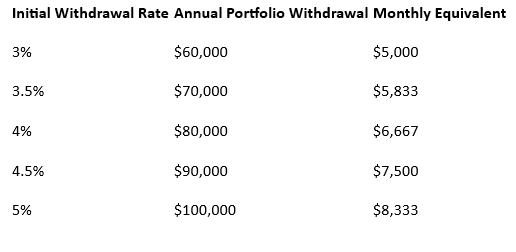
These figures are before taxes and are intended only as illustrations. They do not represent guaranteed income or withdrawal rates appropriate for every household.
The familiar 4% rule suggests an initial withdrawal of $80,000 from a $2 million portfolio, with subsequent withdrawals adjusted for inflation under the traditional framework.
However, the sustainability of any withdrawal strategy depends on your retirement age, investment allocation, market conditions, spending flexibility, and how long the portfolio may need to support you.
Someone leaving Raytheon at 55 may need to plan for 35 to 40 years of retirement. Someone retiring at 67 with Social Security and pension income may have a very different financial outlook.
We explore these considerations in Retirement Planning Beyond the 4% Rule.
A withdrawal percentage can help frame the conversation, but it should not be mistaken for a complete retirement plan.
How a Raytheon Pension Could Change the Calculation
For employees with a pension benefit, retirement income planning involves more than deciding how much to withdraw from investments.
Consider a hypothetical Raytheon employee who retires with $2 million in investments and receives a pension of $40,000 annually.
If that individual also receives $35,000 in Social Security benefits and initially withdraws $60,000 from investments, total annual income would be approximately $135,000 before taxes.
Now consider someone with the same $2 million portfolio but no pension.
To generate the same $135,000 in annual income, assuming the same Social Security benefit, that person would need to withdraw $100,000 from investments.
That is a 5% initial portfolio withdrawal rather than 3%.
The difference is meaningful, particularly over a retirement that may last several decades.
Of course, pension decisions involve additional considerations.
Depending on your plan, you may need to evaluate different payment forms, survivor benefits, or other available elections. The appropriate choice may depend on your spouse's financial circumstances, health, other assets, and long-term income needs.
Some employees may also have decisions involving lump-sum distributions, although those options should never be assumed to be available without reviewing the specific plan provisions.
These elections can have lasting consequences, which makes it important to evaluate them as part of your overall financial plan.
Your 401(k) Is Only One Piece of the Retirement Puzzle
Raytheon employees may accumulate substantial assets in employer-sponsored retirement accounts over the course of their careers.
Those accounts can provide valuable flexibility, but the tax treatment of the money matters.
Traditional 401(k) assets generally have not yet been subject to income tax. Withdrawals are typically taxable as ordinary income.
Roth assets may offer tax-free qualified withdrawals, while investments held in taxable accounts are subject to different capital gains and income tax rules.
A household with $2 million primarily in traditional retirement accounts may have different after-tax spending power than a household with the same amount spread among traditional accounts, Roth accounts, and taxable investments.
This distinction becomes particularly important when coordinating portfolio withdrawals with pension payments and Social Security benefits.
A pension may provide dependable income, but it can also affect your tax bracket and the attractiveness of certain planning strategies.
The goal is to understand how each income source interacts with the others.
Consider Your Retirement Date Before Making a 401(k) Rollover
For Raytheon employees contemplating retirement before age 59½, the timing of separation from service deserves careful attention.
Withdrawals from retirement accounts before age 59½ are generally subject to a 10% additional tax unless an exception applies.
One potentially valuable exception is commonly called the Rule of 55.
Under certain circumstances, if you separate from service during or after the calendar year in which you turn 55, distributions from that employer's qualified retirement plan may be exempt from the 10% early withdrawal penalty.
This exception does not generally apply to IRA withdrawals.
That distinction matters because rolling your Raytheon 401(k) into an IRA immediately after leaving the company could eliminate access to the Rule of 55 exception for those funds.
A rollover may still be appropriate, but it should be evaluated in light of your age, cash flow needs, investment options, plan rules, and broader financial circumstances.
We discuss this issue in The Rule of 55: What to Know Before Rolling Over Your 401(k).
For someone considering retirement in their mid-to-late 50s, understanding these rules before leaving Raytheon can help preserve valuable options.
Company Stock and Concentration Risk Deserve Attention
Employees sometimes accumulate exposure to their employer's stock through compensation arrangements, investment elections, or other programs.
For Raytheon employees, it is important to distinguish between the Raytheon business and its publicly traded parent company, RTX Corporation.
If you hold RTX shares, those investments should be evaluated alongside the rest of your portfolio.
Owning shares in a company you know well can feel comfortable, particularly after spending many years working there.
But familiarity does not eliminate investment risk.
If a substantial portion of your financial wealth is tied to RTX stock, you may be exposed to a concentration of risk that is not obvious when reviewing your overall account balances.
Your career, compensation history, and investment portfolio may already have meaningful connections to the same business.
As retirement approaches, it is worth considering whether your investment allocation reflects your future financial needs rather than your professional history.
Diversification decisions can also involve taxes, especially when company shares have appreciated significantly.
For employees holding employer securities inside a qualified retirement plan, specialized tax provisions such as net unrealized appreciation may be relevant in certain circumstances. Those rules are complex and depend on the nature of the holdings and distribution.
Before selling, transferring, or rolling over significant employer-stock positions, it is worth evaluating the potential tax consequences.
Retirement Can Create Opportunities for Roth Conversions
The period between leaving Raytheon and beginning required minimum distributions may offer opportunities to manage future income taxes.
For example, suppose you retire at 60 and delay claiming Social Security.
If your taxable income declines after leaving work, you may have several years during which converting portions of a traditional IRA to a Roth IRA could be attractive.
A Roth conversion generally creates taxable income in the year of conversion, but qualified future withdrawals from the Roth account may be tax-free.
The strategy may be particularly useful when current tax rates are expected to be lower than future rates.
However, Raytheon employees with pension income may have less room in lower tax brackets than someone whose retirement income comes entirely from investments.
The amount and timing of pension payments, capital gains, and other income sources all influence the analysis.
Roth conversions can also affect future Medicare premiums because Medicare generally considers income from two years earlier when determining certain surcharges.
We discuss the broader considerations in Should You Convert Your Traditional IRA to a Roth?
The objective is not to convert as much money as possible. It is to evaluate whether conversions could improve your long-term after-tax financial position.
Healthcare Planning Is Especially Important if You Leave Raytheon Before 65
For employees considering retirement before Medicare eligibility, healthcare coverage can be one of the most significant planning issues.
While working, you may have access to employer-sponsored medical benefits that are familiar and relatively straightforward to manage.
Leaving the company can change that arrangement.
Depending on your eligibility and the benefits available to you, you may need to consider retiree medical coverage, coverage through a spouse's employer, COBRA, or an individual health insurance policy.
Do not assume that your current employer coverage will continue after retirement. The available options and costs should be confirmed before you establish a retirement date.
For someone retiring at 58, healthcare planning may need to account for seven years of coverage before Medicare eligibility.
Those expenses can materially affect the amount withdrawn from investments during the early years of retirement.
Once Medicare begins, additional decisions arise involving Parts B and D, supplemental coverage, and out-of-pocket costs.
Higher-income households may also be subject to Medicare's Income-Related Monthly Adjustment Amount, or IRMAA.
Pension income, investment gains, retirement account withdrawals, and Roth conversions can all influence the income calculations used to determine these surcharges.
We explore Medicare considerations in Navigating Medicare: What Retirees Need to Know.
Healthcare should be incorporated into your retirement cash flow projections rather than treated as an expense to figure out after leaving work.
Market Risk Does Not Disappear When You Retire
Someone who has accumulated $2 million through decades of saving and investing has likely experienced several market cycles.
During the accumulation years, market declines can be uncomfortable, but continued contributions may allow you to purchase investments at lower prices.
Retirement changes that relationship.
Once you begin withdrawing money from your portfolio, poor investment returns early in retirement can have a disproportionate effect on long-term sustainability.
This is known as sequence-of-returns risk.
Consider two households with similar portfolios and identical spending needs.
One experiences strong investment returns during the first several years of retirement. The other experiences a significant market decline shortly after leaving work.
Even if their average long-term returns eventually look similar, the household experiencing early losses may face greater challenges because withdrawals reduce the amount of capital available to participate in a recovery.
For Raytheon employees with pensions, dependable income may reduce the amount that needs to be withdrawn from investments during unfavorable markets.
For those without pensions, portfolio liquidity and spending flexibility may become even more important.
An appropriate retirement investment strategy should consider both long-term growth and the practical need to fund expenses through different market environments.
Do Not Overlook Inflation and Changing Spending Patterns
Retirement expenses rarely remain constant.
During the early years, you may spend more on travel, hobbies, home improvements, or activities you postponed while working.
Later, some discretionary expenses may decline while healthcare and other needs increase.
Inflation adds another layer of uncertainty.
If a household spends $120,000 annually and inflation averages 3%, maintaining the same purchasing power would require approximately $217,000 annually after 20 years.
That is an illustration, not a prediction of future inflation.
Pension benefits also deserve attention because not every pension includes cost-of-living adjustments.
A fixed pension payment can provide valuable income stability, but its purchasing power may decline over time.
Understanding whether your pension includes inflation protection is therefore an important part of evaluating your long-term retirement income.
What Do You Want Life After Raytheon to Look Like?
Many Raytheon employees spend their careers working in environments that emphasize precision, problem-solving, accountability, and long-term objectives.
Those skills can be valuable in retirement planning, but the transition also involves questions that cannot be answered by a spreadsheet.
After years of demanding work, what would you like more time to do?
Perhaps you want to travel while you are healthy and active. You may want to spend more time with family, mentor younger professionals, volunteer, or become involved in charitable organizations.
You might also discover that you enjoy working and would prefer to continue in a different capacity.
Retirement does not have to mean leaving behind the interests, skills, and relationships that have been important throughout your career.
For many people, reaching their point of choice means having the freedom to determine how those interests fit into the next chapter.
We explore the relationship between financial independence and personal fulfillment in The Most Important Retirement Asset Is Not Your Money, It Is Your Time.
Your financial resources should support the life you want to lead, not simply provide a balance you hope never to spend.
Frequently Asked Questions About Retiring From Raytheon With $2 Million
Can a Raytheon employee retire with $2 million?
Yes, $2 million may support a comfortable retirement, depending on spending needs, retirement age, pension eligibility, Social Security benefits, taxes, and other circumstances. Some employees may be financially prepared with less, while others may need more to support their goals.
Do all Raytheon employees receive a pension?
No. Pension eligibility and benefits depend on factors such as employment history, applicable retirement plans, and legacy company arrangements. Employees should review their individual benefit statements and plan documents rather than assuming their benefits match those of coworkers.
Should I roll over my Raytheon 401(k) when I retire?
Not necessarily. A rollover may offer advantages, but the decision should account for investment options, fees, creditor protections, withdrawal needs, tax considerations, and potential access to the Rule of 55. Employer-stock holdings may also require special analysis.
How does a Raytheon pension affect my retirement income plan?
A pension can provide a source of income that reduces the amount you need to withdraw from investments. However, the benefit amount, payment form, survivor elections, inflation protection, and tax treatment should all be evaluated.
Is it better to retire from Raytheon at 55, 60, or 65?
The appropriate retirement age depends on your financial resources, pension provisions, healthcare coverage, account access, Social Security strategy, and personal priorities. Different retirement dates can produce meaningfully different financial outcomes.
Should I consider Roth conversions after leaving Raytheon?
Possibly. Roth conversions may be attractive during years when your taxable income is relatively low. Pension payments, investment income, future required minimum distributions, and Medicare premium surcharges should all be considered before implementing a conversion strategy.
Our Perspective: Retirement Readiness Is About More Than a Number
For Raytheon employees, retirement planning often involves decisions that extend beyond the amount accumulated in a 401(k).
Pension provisions, employer-sponsored benefits, company stock, retirement timing, taxes, and healthcare coverage can all influence the financial choices available to you.
A $2 million portfolio may create substantial flexibility, but it is not a universal measure of retirement readiness.
The more important question is whether your combined financial resources can support the life you want to lead.
At Stordahl Capital Management, we believe financial planning should help you reach your point of choice with greater clarity and confidence.
That means understanding the financial implications of leaving Raytheon, coordinating your retirement benefits with your personal investments, and making thoughtful decisions about how you want to use the years ahead.
If you are approaching retirement from Raytheon and would like to discuss how your pension, retirement savings, and other financial resources fit together, we welcome the opportunity to talk. You can schedule a complimentary 15-minute call.
A Weekly Perspective on Planning and Markets
Each week, we share The Week in Review — a short collection of articles on
financial planning and wealth management, along with a brief overview for context.
One email per week. No promotions, no sales – just clarity.
This material was written in collaboration with artificial intelligence (ChatGPT) and derived from sources believed to be correct.
Stordahl Capital Management, Inc is a Registered Investment Adviser. This commentary is solely for informational purposes and reflects the personal opinions, viewpoints, and analyses of Stordahl Capital Management, Inc. and should not be regarded as a description of advisory services or performance returns of any SCM Clients. The views reflected in the commentary are subject to change at any time without notice. Nothing in this piece constitutes investment advice, performance data or any recommendation that any particular security, portfolio of securities, transaction or investment strategy is suitable for any specific person. Any mention of a particular security and related performance data is not a recommendation to buy or sell that security. Advisory services are only offered to clients or prospective clients where Stordahl Capital Management and its representatives are properly licensed or exempt from licensure. No advice may be rendered by Stordahl Capital Management unless a client service agreement is in place. Stordahl Capital Management, Inc provides links for your convenience to websites produced by other providers or industry-related material. Accessing websites through links directs you away from our website. Stordahl Capital Management is not responsible for errors or omissions in the material on third-party websites and does not necessarily approve of or endorse the information provided. Users who gain access to third-party websites may be subject to the copyright and other restrictions on use imposed by those providers and assume responsibility and risk from the use of those websites. Please note that trading instructions through email, fax, or voicemail will not be taken. Your identity and timely retrieval of instructions cannot be guaranteed. Stordahl Capital Management, Inc. manages its clients’ accounts using a variety of investment techniques and strategies, which are not necessarily discussed in the commentary. Investments in securities involve the risk of loss. Past performance is no guarantee of future results.
Stordahl Capital Management is an independent registered investment adviser and is not affiliated with, endorsed by, or sponsored by Raytheon, RTX Corporation, or any of their affiliates.